


Quick Summary
Full grain leather is often worth the investment because it is the strongest, most breathable part of the hide and keeps its natural grain. Its real value comes from durability and repairability, which lower the cost per year of use, though it costs more up front than top-grain or synthetic options.
- Full grain leather is the uncorrected, unsanded outer surface, so its tight fibers stay intact.
- Check labels and ask sellers whether the hide is full grain and whether the surface is sanded or coated.
- A full grain bag typically costs more up front but can be repaired for a fraction of replacement cost.
- Routine conditioning every few months helps the leather last and develop a desirable patina.
- Full grain shows water spots and natural marks, so it suits buyers who accept some wear.
Table of Contents
- What Full-Grain Leather Is and How It Is Made
- Full-Grain vs. Top-Grain Leather: What Changes in Your Bag
- How to Identify Full-Grain Leather Before You Buy
- What Full-Grain Leather Actually Costs Over Time
- Caring for Full-Grain Leather So It Lasts
- Choosing a Full-Grain Bag That Fits Your Working Life
- Frequently Asked Questions
What Full-Grain Leather Is and How It Is Made
Last Updated: November 1, 2026
Full-grain leather is the top layer of the hide, with the natural grain left intact. Full-grain is often valued because it is the strongest, most breathable part of the hide. Is full grain leather worth investment? For many buyers, the answer is yes, but only if you understand what you are paying for.
Full-grain leather is defined as the uncorrected, unsanded outer surface of the hide. Nothing is ground off to hide flaws, so the fibers stay tight and the surface keeps its natural markings.
How full-grain leather is made
The process starts with tanning, which preserves the hide and sets its structure. The hide is then cleaned, dyed, and finished. Full-grain leaves the surface alone, so the natural texture and any small variations in the hide remain visible.
Full-Grain vs. Top-Grain Leather: What Changes in Your Bag
Top-grain leather is the next layer down after surface correction. For a deeper comparison of leather grades and how they change bag construction, see our quality leather handbags buyer's guide. The top surface is sanded and treated to create a uniform appearance. This makes it more consistent in color and easier to produce, but it removes some of the tightest fibers. Expect top-grain to look smoother and cost less, while full-grain shows more character and tends to age more gracefully.
Genuine leather, a common label on handbags, is a lower grade made from the split or lower layers of the hide. It is not the same as full-grain, despite the similar name. Corrected-grain, bonded leather, and faux leather are further down the scale.
How to Identify Full-Grain Leather Before You Buy
Labels are a starting point, not proof.
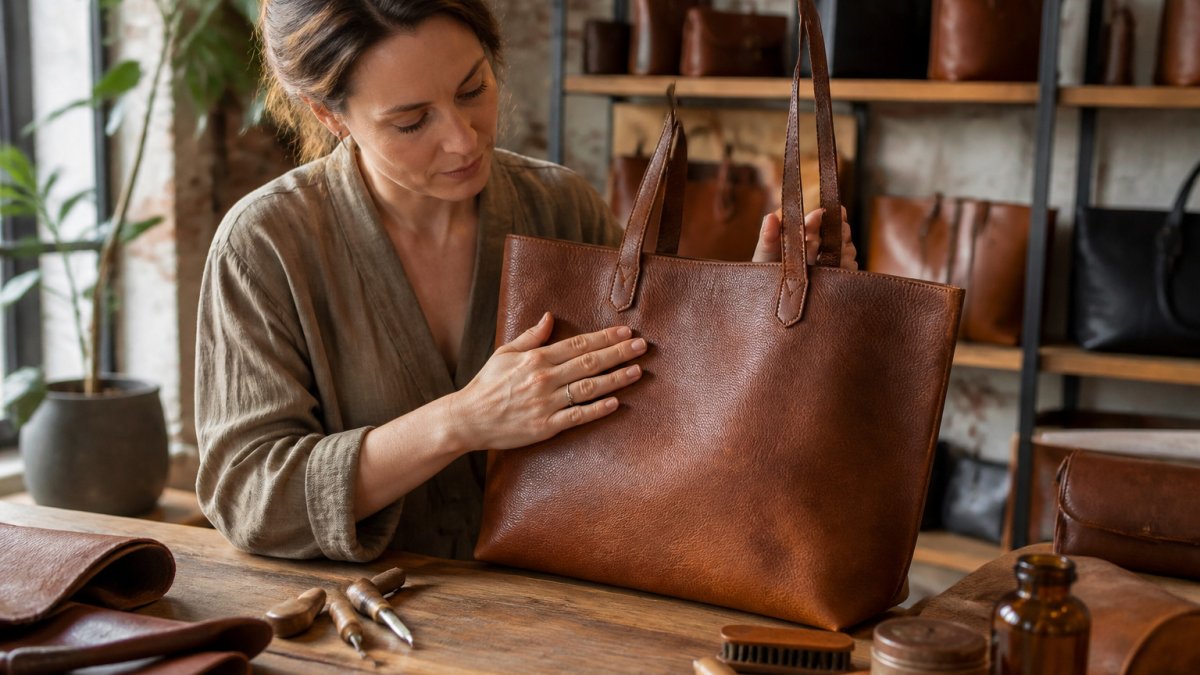
1. Look at the surface, not the shine. Full-grain shows small pores, natural markings, and slight variations in texture across the panel.
2. Check the edge. Look at a cut edge or the underside of a strap. Full-grain edges show tight, dense fibers that blend into the surface layer.
3. Press and release. Press a thumbnail gently into the surface. Full-grain usually shows fine, irregular creasing that relaxes when you let go.
4. Smell it. Full-grain leather smells like tanned hide, earthy and slightly animalic. Faux leather smells like plastic or chemicals.
5. Read the full description, not the headline. Look for terms like "full-grain," "top-grain," "corrected-grain," "bonded," or "genuine leather." Be cautious of vague labels.
6. Ask about construction and repairability. A full-grain hide on a glued, unrepairable bag is a weaker investment than a full-grain hide on a stitched bag with replaceable hardware.
Watch out: a bag labeled as leather with no grade stated may be bonded or corrected. Ask the seller directly before paying a premium price. If the seller cannot or will not answer basic questions about the hide and construction, that is itself useful information.
Handmade in Texas Leather Wallet →
What Full-Grain Leather Actually Costs Over Time
A full-grain bag typically costs more up front than a department-store alternative. The question is what happens over several years. A bag that lasts a decade spreads its cost across far more use than one that needs replacing in two seasons.
Purchase price. Full-grain commands a premium because only the top layer of the hide qualifies and the hide selection is less forgiving. Expect to pay more than you would for top-grain or a synthetic bag of the same size.
Routine care. A full-grain bag generally benefits from a leather conditioner and a soft cloth every few months. Annual care costs vary depending on the products you choose.
Repair. This is where the math tilts. A cobbler or leatherworker can often restitch a strap, replace a zipper pull, or patch a lining on a full-grain bag for a fraction of replacement cost.
Replacement. Over a decade, a cheaper bag replaced every two years can cost more in total than a full-grain bag that is kept and repaired, because the full-grain bag is still in service at the end. Dividing total cost by years of use can make full-grain look like a lower cost per year, especially once repair is on the table.
Durability, patina, and expected lifespan
Full-grain leather develops a patina, a soft darkening and wear pattern that comes from handling and light exposure. Many buyers value this. It is also the main reason a well-kept bag can outlast a cheaper synthetic one. Exact lifespan depends on use, climate, and care, so no one can promise a number of years. Full-grain bags used daily and conditioned a few times a year can stay in service for many years, while bonded and faux-leather bags may fail at seams, coatings, and handles sooner. Construction matters as much as the hide, stitched, riveted, and lined bags outlast glued ones. Tanning also plays a role: vegetable-tanned full-grain tends to darken and stiffen with age, while chrome-tanned full-grain stays softer and more color-stable. If you want the longest service life, prioritize full-grain hide, stitched construction, and a repairable design over a brand name.
Limitations and trade-offs
Full-grain leather is heavier, shows water spots, and changes color with wear. It needs conditioning and is not ideal for every climate or activity. If you want a perfectly uniform look that never changes, top-grain or a synthetic may suit you better. It also shows natural marks, scars, insect bites, and grain variation, that some buyers read as character and others read as flaws. In very wet climates, unsealed full-grain can spot; in very dry climates, it can dry out faster without conditioning. None of these are deal-breakers, but they are the reasons full-grain is not the right answer for every buyer.
The article's price and cost-bucket details for full-grain bags can be scanned at a glance:
| Item | Value | Note |
|---|---|---|
| Handmade in Texas Leather Tote | $160.00 | Daily carry, structured |
| Handmade in Texas extra Large Leather Tote | $150.00 | Extra large capacity |
| Handmade in Texas Oversized Leather Tote | $172.00 | Oversized capacity |
| Handcrafted Distressed Leather Shoulder Bag | $175.00 | Distressed finish |
| Handmade in Texas Leather Wallet | $78.00 | Smaller accessory option |
| Routine care | Every few months | Leather conditioner and soft cloth |
| Repair | Fraction of replacement cost | Restitching, zipper pulls, lining patches |
Caring for Full-Grain Leather So It Lasts
Keep leather away from prolonged heat and direct sun. Wipe spills promptly with a dry cloth. Condition the surface periodically with a product suited to leather, testing it on a hidden spot first. Store the bag stuffed lightly with paper or cloth so it keeps its shape.
Choosing a Full-Grain Bag That Fits Your Working Life
Full-grain is worth the investment when you carry a bag daily and want it to look better over time. For a structured daily carry, the Handmade in Texas Leather Tote suits most office routines. If you need more capacity for files and devices, the Handmade in Texas Oversized Leather Tote or the extra Large Leather Tote gives you more room. For a smaller accessory to pair with a bag, the Handmade in Texas Leather Wallet holds full paper bills with a sewn-in card holder. Our guide to 7 Professional Leather Bags for Work Worth Carrying compares more options against the criteria above.


Frequently Asked Questions
Does full-grain leather last longer than other types of leather?
Generally, yes. Full-grain leather keeps the outermost layer of the hide intact, including the tightest and strongest fibers, so it resists abrasion and tearing better than top-grain or corrected-grain leather. Its surface also develops patina rather than cracking or peeling. Lifespan still depends on how the bag is used and cared for, so a well-made full-grain tote used daily for years is a realistic expectation, while cheap bonded or faux leather typically shows wear within a shorter period.
Why is full-grain leather more expensive?
Full-grain leather is more expensive because the tannery leaves the hide's natural surface unsanded and uncorrected, which means only the best hides qualify and more of each hide is usable only for lower grades. Handmade construction and hand finishing can add labor cost on top of the material. Buyers pay for a surface that ages well and a structure that holds its shape for years, rather than a sanded layer printed with an artificial grain.
How do you care for a full-grain leather bag?
Wipe the bag with a dry, soft cloth after use and address spills immediately with a barely damp cloth. Condition the leather with a product made for full-grain hides two to three times a year, applying a thin layer and buffing it off. Store the bag stuffed with tissue in a breathable dust bag, away from direct sun and heat, which can dry the leather and fade the dye. Avoid harsh household cleaners, which strip the natural oils.
Is full-grain leather worth the higher price?
It is worth it for a bag you plan to carry daily for years, especially in a professional setting where durability and a polished look matter. It is less worth it for a trend piece you will replace within a season. Compare the price per year of use rather than the sticker price: a $172.00 handmade oversized tote carried for many years may cost less per use than a cheaper bag replaced every year or two. Full-grain bags also show individuality as they age, which some buyers value and others find a drawback.
Full-grain leather pays off when you value craftsmanship and expect to carry a piece for years. Explore the full collection and choose the bag that fits your routine.


